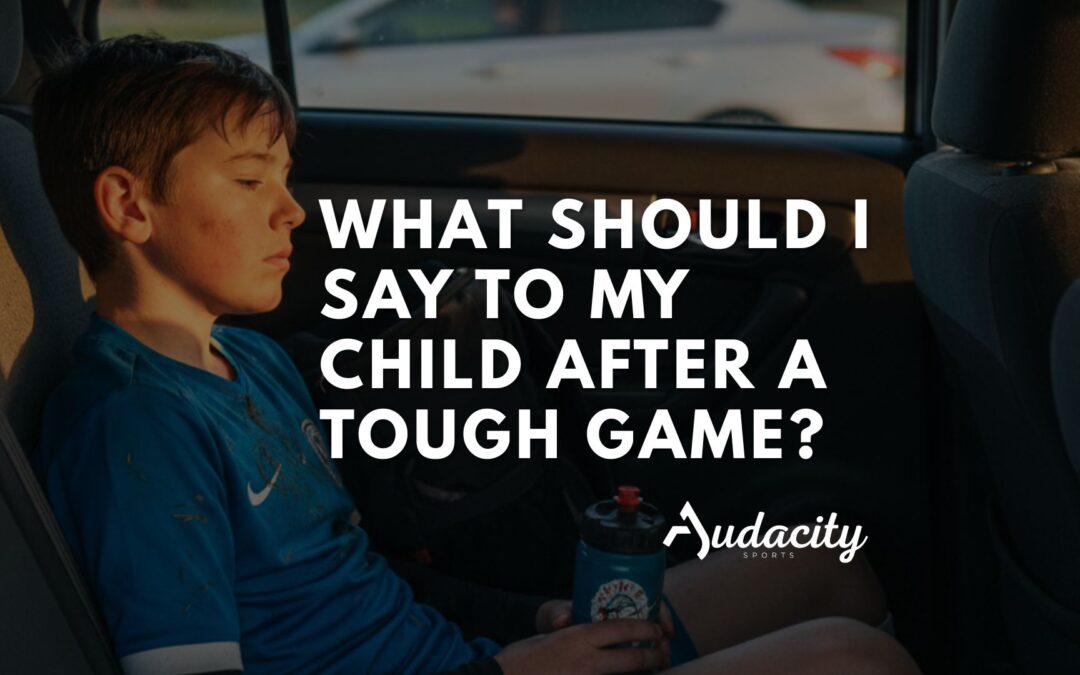
What Should I Say to My Child After a Tough Game?

What Should I Say to My Child After a Tough Game?

Quick Summary: The car ride home after a tough game is one of the most important — and most mishandled — moments in youth sports. Kids are raw, and what a parent says in the first few minutes can either rebuild them or deepen the sting. The short version: lead with connection, not analysis. Ask before you tell. And save the coaching for later, if at all.

Your kid isn’t looking for a post-game analyst on the ride home. They’re looking for a parent.

What should I say to my child after a tough game?

Start with five simple words: “I love watching you play.” Sports psychologists have pointed to this phrase for years because it does something powerful — it separates your love and approval from the result. After a loss, a kid is already wondering if they let you down. Leading with connection answers that fear before it grows.

Then go quiet. Let them set the tone. Some kids want to talk; many just want to feel normal again. Both are fine.

What should I avoid saying?

Avoid the instant breakdown of what went wrong, even when you mean well. In the raw minutes after a loss, “you should have…” lands as “you failed.” Also skip blaming refs, coaches, or teammates — it teaches kids to look outside themselves instead of focusing on what they control.

“In the raw minutes after a loss, ‘you should have’ lands as ‘you failed.’”

What is the best first question to ask?

Ask about experience before performance. A simple, low-pressure opener invites them in without putting them on trial.

The Ride-Home Reset
Three moves, in order
1. Connect
“I love watching you play.” Approval first, before anything about the game.
2. Ask
“What was that like for you?” Let them lead. Listen more than you talk.
3. Wait
Save any teaching for the next day, once the emotion has cooled — if it’s needed at all.

Why does the car ride home matter so much?

Because it repeats. Multiply one ride home by a whole season and you are training your child’s relationship with failure itself. Handled well, tough games become reps in resilience. Handled poorly, they become reasons to dread playing — and eventually, reasons to quit.

Frequently asked questions

What if my child wants to vent or cry?

Let them. Validate the feeling without rushing to fix it: “That one hurt — I get it.” Emotions move through faster when they are allowed, not argued with.

When is it okay to give feedback?

Later, and only if they are open to it. The next day, you can ask, “Want to talk about that play?” If they say no, respect it. Their coach handles coaching; you handle support.

My child shuts down completely. Is that bad?

No. Silence is a normal way to process. Stay present, keep it light, and let them know you are there when they are ready.

Win the ride home, and you win the season.

Audacity Sports — Mental Performance Academy for Youth Athletes

Why Do Some Kids Thrive Under Pressure While Others Crumble?

Why Do Some Kids Thrive Under Pressure While Others Crumble?

Quick Summary: Some kids seem to rise when the game is on the line while others freeze — and it is almost never about who has more talent. Thriving under pressure is a set of mental skills: settling the nerves, narrowing focus to the next play, and self-talk that helps instead of hurts. Those skills are teachable, and the RISE Method gives parents a simple way to start coaching them.

Pressure doesn’t create your child or break them. It reveals what they were trained to do with it.

Why do some kids thrive under pressure while others fall apart?

Watch two kids in the same high-stakes moment — last at-bat, game on the line — and you will often see two completely different athletes. One slows down and locks in. The other speeds up, tightens, and disappears. Parents tend to read this as a personality trait: one kid is just clutch, the other is not.

That read is wrong, and it is costly. The difference usually is not nerve or character. It is whether anyone ever taught that child what to do with the surge of adrenaline a big moment creates. The kid who thrives is not feeling less pressure. They have simply practiced a response to it.

Is performing under pressure a talent or a skill?

A skill. The body’s pressure response — racing heart, tunnel vision, shaky hands — is universal. Elite performers feel it too. What separates them is a trained routine for channeling it: a breath, a focal point, a cue word. None of that is innate. It is rehearsed until it becomes automatic, the same way a jump shot is.

“The kid who thrives isn’t feeling less pressure. They’ve practiced a response to it.”

What do pressure-proof kids do differently?

Three habits show up again and again in young athletes who stay composed when it counts:

What Pressure-Proof Kids Do
Three trainable habits
Play the controllables
They focus on effort, position, and the next action — not the scoreboard or the outcome.
Run a reset routine
A breath, a tap, a word — a quick physical cue that clears the last mistake and starts the next play.
Coach their own voice
They talk to themselves the way a good coach would — steady and constructive, not harsh.

How can parents help a child handle pressure?

Start before the pressure shows up, not during it. Practice a simple pre-performance routine at home so it is automatic by game day. Keep your own sideline energy calm — kids borrow their nervous system from the adults around them. And debrief games by asking about effort and decisions, not just results. This is the heart of the RISE Method: Regulate the body, Identify the feeling, Speak a better script, and Execute the next controllable action.

Frequently asked questions

My child is talented in practice but freezes in games. Why?

Practice has no pressure, so the physical skills flow. Games add adrenaline the child has not been taught to manage. The fix is rehearsing composure, not more reps of the physical skill they already have.

Can you really teach a kid to be clutch?

Yes. Composure under pressure is a trainable routine — breathing, focus cues, and self-talk — not a fixed personality trait. Kids get measurably calmer with practice.

At what age can kids learn this?

As early as 7 or 8, in simple forms. Younger kids start with one breath and one cue word; older kids build full pre-performance routines.

Pressure is trainable. So is the kid who learns to use it.

Audacity Sports — Mental Performance Academy for Youth Athletes

Why Do Kids Quit Sports by Age 13? The Untrained Mental Game

Why Do Kids Quit Sports by Age 13? The Untrained Mental Game

Quick Summary: Roughly 70% of kids quit organized sports by age 13, and it is rarely about talent or losing their love for the game. Most walk away because the mental side of sport — the pressure, the nerves, the fear of failing in front of people — is the one part nobody ever trained them to handle. The encouraging news: those mental skills are learnable, not fixed. A simple framework called the RISE Method (Regulate, Identify, Speak, Execute) gives parents a way to coach them at home.

70%
of kids quit organized sports by age 13

Why do so many kids quit sports by age 13?

It is one of the most consistent findings in youth athletics: about 7 in 10 kids step away from organized sports before they finish middle school. Parents often assume their child simply lost interest or was not good enough. The reality is usually different.

When you ask kids directly, the reasons cluster around a few themes:

  • It stopped being fun. What started as play became a source of stress.
  • Too much pressure. The fear of letting down a coach, a parent, or teammates outweighed the joy of competing.
  • Fear of making mistakes. One bad game or one missed shot started to feel like a verdict on who they are.
  • No way to handle the nerves. The physical skills were there, but the moment got too big and nobody taught them how to settle themselves down.

Notice what is missing from that list: talent. Most kids do not quit because they cannot play. They quit because the experience became emotionally heavier than it was worth.

“Most kids don’t quit because they can’t play. They quit because the experience became heavier than it was worth.”

The part of every young athlete nobody trains

Think about how a typical young athlete spends their week. Drills, conditioning, footwork, reps. Every bit of it trains the body. Almost none of it trains the mind.

Yet ask any athlete what decided their biggest games and they will tell you it was confidence, composure, or focus — not their forty time. The mental game is the untrained half of every young athlete, and it quietly determines whether they rise or quit.

“The mental game is the untrained half of every young athlete.”

Is the mental game something kids are just born with?

No. This is the myth that does the most damage. We treat composure and confidence as fixed traits — your kid either has it or they do not. They are skills. A child who falls apart after a mistake today can learn to reset and refocus, the same way they learned to dribble or field a grounder. It takes coaching and practice, not better genes.

How can parents help? The RISE Method

You do not need a sports psychology degree to start. The RISE Method breaks the mental game into four steps you can reinforce on the car ride home or before a game.

The RISE Method
Four steps to train the mental game

R

Regulate
Calm the nervous system with slow breathing and a pre-game routine.

I

Identify
Name the feeling and the thought behind it. You cannot manage what you cannot name.

S

Speak
Reframe the inner voice into a kinder, more useful script.

E

Execute
Shift focus to the next controllable action, not the outcome.

R — Regulate

Before anything else, help your child manage their nervous system. Slow breathing, a physical reset, a routine before they step on the field. A regulated body is the foundation for a clear mind.

I — Identify

Teach them to name what they are feeling and the thought behind it. “I am nervous because I am scared to mess up” is a workable starting point. You cannot manage what you cannot name.

S — Speak

Reframe the inner voice. The story a kid tells themselves after a mistake — “I am terrible at this” versus “that is one play, next one” — shapes what happens next. Help them build a kinder, more useful script.

E — Execute

Shift attention from the outcome to the next controllable action. Not “we have to win” but “win the next play.” Execution lives in the present, where nerves lose their grip.

Frequently asked questions

At what age should kids start mental performance training?

As soon as they start competing in a way that creates pressure — often as early as 7 or 8. The skills are introduced in age-appropriate ways: simple breathing and self-talk for younger kids, more detailed routines as they mature.

Is not pushing through nerves just part of sports?

Some discomfort is normal and even healthy. The problem is expecting kids to push through without ever teaching them how. That is what leads to burnout and quitting, not the nerves themselves.

What should I do if my child says they want to quit?

Get curious before you react. Ask what specifically is not fun anymore. Often the answer points to pressure or fear of failure — exactly the things mental performance skills are built to address — rather than a true loss of interest in the sport.

Train the mental game. Keep them in the game they love.

Audacity Sports — Mental Performance Academy for Youth Athletes

Let Kids Play Act 2026: What You Need to Know About the Bill Banning Private Equity from Youth Sports

Let Kids Play Act 2026: What You Need to Know About the Bill Banning Private Equity from Youth Sports

Quick Summary: The Let Kids Play Act, introduced May 14, 2026, would ban private equity firms from youth sports, force refunds to families for junk fees, and create a Youth Sports Fund. The bill addresses youth sports costs that have risen 46% in recent years, now averaging over $5,000 per year for club sports.


What Is the Let Kids Play Act?

The Let Kids Play Act is federal legislation introduced by Congressman Pat Ryan (D-NY) on May 14, 2026, that would ban private equity investment firms from owning or operating youth sports organizations, including leagues, facilities, tournaments, and player platforms. The bill requires existing private equity owners to exit within two years and provides refunds to families who have been overcharged.

Key Sponsors:

  • Lead Sponsor: Rep. Pat Ryan (D-NY)
  • Co-Sponsors: Rep. Chris Deluzio (D-PA), Rep. Angie Craig (D-MN), Rep. Pramila Jayapal (D-WA)
  • Senate Lead: Senator Chris Murphy (D-CT)
  • Senate Co-Sponsor: Senator Cory Booker (D-NJ)

Why Congress Is Targeting Private Equity in Youth Sports

The Youth Sports Cost Crisis: Key Statistics

Private equity firms have transformed youth sports into a $40 billion industry over the past decade. Here’s how the takeover has impacted families:

Cost Increases:

  • Youth sports participation costs have increased 46% in recent years
  • Average annual cost for club sports: $5,000+ per child
  • Many families are going into debt to afford youth sports participation

Market Impact:

  • Private equity firms have purchased leagues, teams, facilities, tournaments, and player tracking platforms
  • Lower-income families participate in youth sports at half the rate of wealthier families
  • Millions of children have been priced out of sports entirely

What Private Equity Firms Control:

  • Youth sports leagues and teams
  • Practice facilities and venues
  • Tournament circuits
  • Uniforms and merchandise
  • Streaming services
  • Hotels for travel sports
  • Player data platforms

According to the bill’s sponsors, private equity firms use their market power to impose higher prices, junk fees, and mandatory multi-year contracts, effectively turning community sports into profit extraction schemes.


What Does the Let Kids Play Act Do? Five Key Provisions

1. Automatic Ban on Private Equity Firms

What it does: Private equity firms are automatically designated as “vulture investors” and banned from owning or operating youth sports organizations.

Timeline: Banned investors must sell their ownership stakes and management rights within two years of the law’s enactment.

Scope: The ban covers leagues, facilities, tournaments, and player platforms.

2. Mandatory Refunds for Families

What it does: Vulture investors must provide full refunds for junk fees collected through predatory practices.

Additional relief:

  • Cancellation of predatory multi-year contracts
  • Elimination of outstanding debts imposed by private equity firms
  • Forgiveness of interest and late fees

Financial impact: Families who have paid inflated prices or hidden fees would receive their money back.

3. Personal Liability for Private Equity Investors

What it does: Private equity vulture investors are held personally and financially responsible for:

  • Debts incurred while managing youth sports organizations
  • Legal judgments
  • Law violations, including child safety and labor infractions

Why it matters: This closes common liability loopholes that allow investment firms to extract profits while avoiding responsibility for harm.

4. Creation of a Youth Sports Fund

What it does: Penalties and recovered funds from private equity firms are placed into a dedicated Youth Sports Fund.

Fund purposes:

  • Provide scholarships for lower-income families
  • Reduce participation costs across communities
  • Keep local fields open for free community use
  • Invest in accessible youth sports infrastructure

5. Legal Standing for States and Families

What it does: Gives states and parents the legal right to:

  • Sue private equity firms operating in youth sports
  • Stop predatory practices through legal action
  • Receive compensation for financial losses or harm

Why it matters: Parents would have real legal recourse if they’ve been exploited by vulture investor practices.


Why This Matters

Youth sports teach children critical life skills including teamwork, discipline, resilience, and community engagement. When millions of kids are priced out of these experiences, society loses opportunities to develop well-rounded young people.

As Congressman Pat Ryan stated: “Team sports are supposed to be the first place our kids learn teamwork, discipline, and community. Instead, it’s become a cash grab for Wall Street investors to make another buck while our kids miss out on this fundamental part of American childhood.”

Societal Impact:

  • Youth sports participation linked to improved academic performance
  • Sports teach conflict resolution and emotional regulation
  • Team sports build social connections and community ties
  • Athletic participation associated with lower rates of depression and anxiety in youth

Economic Justice Issue: The current system creates a two-tier youth sports landscape where wealthy families can afford elite training and exposure, while lower-income talented athletes are excluded from opportunities.


Frequently Asked Questions About the Let Kids Play Act

When was the Let Kids Play Act introduced?

The Let Kids Play Act was introduced on May 14, 2026, by Congressman Pat Ryan and co-sponsors in the House of Representatives, with companion legislation led by Senator Chris Murphy in the Senate.

How much do youth sports cost now?

The average cost of club sports exceeds $5,000 per year per child. Youth sports participation costs have increased 46% in recent years, with some elite travel programs costing $10,000-$15,000 annually when including tournament fees, travel, equipment, and mandatory expenses.

Would the Let Kids Play Act lower youth sports costs?

Yes. The bill would lower costs through multiple mechanisms:

  1. Banning private equity firms that have driven up prices
  2. Requiring refunds for junk fees already collected
  3. Creating a Youth Sports Fund to subsidize participation
  4. Restoring local, community-based ownership that historically kept costs lower

What is private equity?

Private equity refers to investment firms that buy companies using borrowed money, restructure them to maximize profits (often through cost-cutting and price increases), and then sell them for a profit. In youth sports, private equity firms have consolidated ownership of leagues, facilities, and tournaments, using their market control to raise prices significantly.

Who supports the Let Kids Play Act?

Congressional Sponsors:

  • Rep. Pat Ryan (D-NY)
  • Rep. Chris Deluzio (D-PA)
  • Rep. Angie Craig (D-MN)
  • Rep. Pramila Jayapal (D-WA)
  • Sen. Chris Murphy (D-CT)
  • Sen. Cory Booker (D-NJ)

Endorsing Organizations:

  • American Economic Liberties Project (AELP)
  • Groundwork Action
  • Sports Fans Coalition
  • Open Markets Institute
  • Americans for Tax Fairness (ATF)

Notable Supporters:

  • Lina Khan, former FTC Chair
  • Brendan Ballou, author of “Plunder: Private Equity’s Plan to Pillage America”

How long would private equity firms have to exit youth sports?

Private equity firms designated as vulture investors would have two years from the bill’s enactment to sell their ownership stakes and exit the youth sports industry.

Would parents get their money back?

Yes. The bill requires vulture investors to provide full refunds for junk fees collected through predatory practices. It also cancels predatory contracts and eliminates outstanding debts, interest, and late fees imposed by private equity firms.

What sports does the bill cover?

The bill covers all youth sports organizations, including but not limited to:

  • Soccer leagues
  • Baseball and softball organizations
  • Basketball programs
  • Hockey leagues
  • Volleyball clubs
  • Lacrosse organizations
  • Swimming and gymnastics clubs
  • Multi-sport facilities and training centers

Could private equity firms avoid the ban?

The bill automatically designates private equity firms as vulture investors unless they can prove they have never used predatory practices. The burden of proof is on the investment firm, making it difficult to circumvent the ban.

What happens if a private equity firm doesn’t comply?

Non-compliant firms face:

  • Legal action from states and families
  • Financial penalties placed into the Youth Sports Fund
  • Personal liability for owners and managers
  • Potential criminal charges for violations of child safety or labor laws

Will this bill pass?

The bill’s passage depends on congressional support and political momentum. It has bipartisan appeal on the issue of protecting families from predatory business practices, though opposition may come from the private equity industry and its advocates.


Congressional Background and Legislative Context

The Let Kids Play Act was introduced by Congressman Pat Ryan along with his Monopoly Busters Caucus Co-Chairs: Representatives Chris Deluzio, Angie Craig, and Pramila Jayapal. In the Senate, it’s led by Senator Chris Murphy, with support from Senator Cory Booker.

Monopoly Busters Caucus Focus: The caucus addresses corporate consolidation and monopolistic practices across industries, with youth sports representing a clear example of how private equity consolidation harms consumers and communities.

Broader Context: This bill is part of a larger congressional effort to address private equity’s impact on American life, including healthcare, housing, and retail sectors.


Key Takeaways: Let Kids Play Act Summary

✓ Ban on Private Equity: Automatic prohibition on private equity ownership in youth sports
✓ Two-Year Exit: Existing private equity owners must divest within 24 months
✓ Family Refunds: Full refunds for junk fees and cancellation of predatory contracts
✓ Personal Liability: Investment firm owners held personally responsible for violations
✓ Youth Sports Fund: Penalties redirected to scholarships and community sports access
✓ Legal Recourse: States and parents can sue private equity firms
✓ Cost Impact: Addresses 46% cost increase and $5,000+ annual average expenses


Related Youth Sports Policy Topics

Youth Sports Affordability Issues:

  • Pay-to-play sports model
  • Travel sports costs
  • Club sports vs. recreational sports
  • Sports equipment expenses
  • Tournament and registration fees

Private Equity in Community Services:

  • Private equity in youth education
  • Investment firms in childcare
  • Corporate consolidation in family services
  • Wall Street in local communities

Youth Development Policy:

  • Access to extracurricular activities
  • Childhood obesity prevention
  • Community recreation funding
  • Title IX and sports equity
  • Youth mental health through sports

The Bottom Line: Will the Let Kids Play Act Restore Affordable Youth Sports?

Youth sports participation is essential for child development, physical health, and community building. The Let Kids Play Act represents a significant legislative effort to reverse the trend of sports becoming a luxury available only to wealthy families.

If enacted, the bill would:

  • Remove profit-driven investment firms from youth sports
  • Return money to families who have been overcharged
  • Create sustainable funding for accessible youth sports
  • Restore community-based sports ownership models
  • Provide legal protections against future exploitation

Path Forward: The bill must pass through House and Senate committees, receive floor votes in both chambers, and be signed by the President to become law. Its success will depend on sustained advocacy from parents, sports organizations, and communities affected by rising youth sports costs.

For parents struggling with rising costs, for communities that have seen local leagues bought out and transformed, and for the millions of kids who’ve been priced out of participation, this bill offers a potential path back to what youth sports used to be: an accessible opportunity where any child could show up, learn, compete, and grow—regardless of their family’s income.


Additional Resources

Official Bill Documents:

Contact Your Representatives:
To support or oppose this legislation, contact your congressional representatives through:


Article Information:

Tags: youth sports policy, private equity regulation, sports affordability, Let Kids Play Act, Pat Ryan, youth sports costs, club sports expenses, travel sports, pay-to-play sports, sports equity, community sports, HR 2026


This article was sourced from official congressional press releases and public documents. For the most current information on the bill’s status, consult Congress.gov or contact your congressional representatives.

The High School NIL Revolution

The High School NIL Revolution

The High School NIL Revolution

In a historic shift that’s reshaping youth athletics across America, high school athletes can now monetize their name, image, and likeness in 45 states plus Washington, D.C. And in a major development just announced yesterday, Michigan has officially joined the list.

The Michigan High School Athletic Association (MHSAA) approved expanded NIL opportunities effective immediately on January 27, 2026, marking a turning point for Michigan’s 180,000 high school athletes. While MHSAA estimates only about 25 athletes will immediately pursue significant deals, the policy opens doors for countless student-athletes to learn valuable lessons about personal branding, business, and financial responsibility.

The Current Landscape: Where NIL Stands

As of early 2026, the high school NIL landscape has transformed dramatically:

States Allowing NIL (45 + D.C.): The vast majority of states now permit some form of high school NIL, including recent additions like Michigan, Ohio (approved November 2025), Wisconsin, and West Virginia. California led the charge in 2021, and the momentum has only accelerated.

Limited Models: Texas offers a unique approach, allowing only seniors aged 17 and older to sign NIL deals, with payment deferred until college enrollment.

Holdout States: Just five states still prohibit high school NIL entirely: Alabama, Hawaii, Indiana, Mississippi, and Wyoming.

What Michigan Athletes Can (and Can’t) Do

Michigan’s new policy strikes a careful balance between opportunity and protecting the integrity of high school sports. Here’s what student-athletes need to know:

Allowed Activities:

  • Social media endorsements and promotions
  • Personal appearances and speaking engagements
  • Photo sessions and autograph signings
  • Modeling and advertising work
  • Merchandise sales featuring your NIL
  • Sports card deals

Critical Restrictions:

  • No school identity: You cannot use school names, logos, mascots, uniforms, or trademarks in any NIL content
  • Individual only: No group collectives or pay-for-play arrangements
  • Performance-neutral: You can’t capitalize on specific athletic performance, awards, or competition results
  • Time restrictions: NIL activities cannot occur during school hours, at MHSAA events, or on school property
  • Prohibited industries: No deals involving gaming, gambling, alcohol, or banned substances
  • Seven-day disclosure: All NIL opportunities must be reported to MHSAA within seven days

Why This Matters for Young Athletes

The expansion of high school NIL isn’t just about money — though for elite prospects, six-figure deals are becoming reality. It’s about developing skills that will serve athletes long after their playing days end.

Business literacy: Managing contracts, understanding obligations, and building professional relationships are invaluable life skills.

Personal branding: Athletes learn how to authentically represent themselves and create value beyond their on-field performance.

Financial responsibility: Early exposure to earning and managing money teaches crucial lessons about budgeting, taxes, and long-term planning.

Mental resilience: Balancing academic, athletic, and business commitments builds the kind of mental toughness that defines successful people in any field.

The Audacity Sports Perspective: Building Champions Beyond the Scoreboard

At Audacity Sports, we believe in developing complete athletes — young people who understand that true excellence comes from mental performance, character development, and preparation for life beyond sports. The NIL era presents both tremendous opportunities and significant challenges for youth athletes.

The opportunity? Learning to build a brand based on values, authenticity, and consistent effort. Understanding that your worth isn’t just measured by your stats, but by who you are as a person and how you show up in your community.

The challenge? Maintaining balance. Not letting external validation or financial incentives distort your relationship with your sport. Staying grounded when social media metrics and brand deals can create pressure that 16-year-olds shouldn’t have to navigate alone.

This is where mental performance coaching becomes essential. Through our RISE Method, we help young athletes develop:

  • Resilience to handle the pressure of building a public brand
  • Identity rooted in values rather than validation
  • Self-awareness to make decisions aligned with long-term goals
  • Excellence in all areas — athletic, academic, and personal

Navigating NIL: Practical Advice for Athletes and Parents

If you’re a Michigan athlete or parent considering NIL opportunities, here’s how to approach this landscape wisely:

  1. Education first: Understand your state association’s rules completely. In Michigan, review the MHSAA NIL guidelines before pursuing any opportunity.
  2. Seek guidance: Work with parents, coaches, and mentors who understand both the opportunities and pitfalls. Consider consulting with legal or financial advisors for significant contracts.
  3. Stay authentic: The most successful NIL athletes are those who build brands that genuinely reflect their values and interests. Authenticity resonates.
  4. Protect your eligibility: One violation can jeopardize your entire high school career. When in doubt, ask before you sign.
  5. Keep perspective: Your sport should still be about competition, improvement, and the love of the game. NIL is a bonus, not the purpose.
  6. Document everything: Keep written records of all obligations, deliverables, and timelines. Treat NIL opportunities as the business relationships they are.

The Road Ahead

With 45 states now embracing high school NIL, the remaining holdouts face mounting pressure. Families are making relocation decisions based on NIL access. Talented athletes are considering where they can maximize opportunities while still competing at the highest level.

The question is no longer whether high school NIL will exist, but how we ensure it develops in a way that genuinely benefits young athletes rather than exploiting them.

The NIL era has arrived in Michigan and across the country. For student-athletes willing to approach it thoughtfully, with strong support systems and a commitment to maintaining balance, it represents an unprecedented opportunity to learn, grow, and build a foundation for future success.