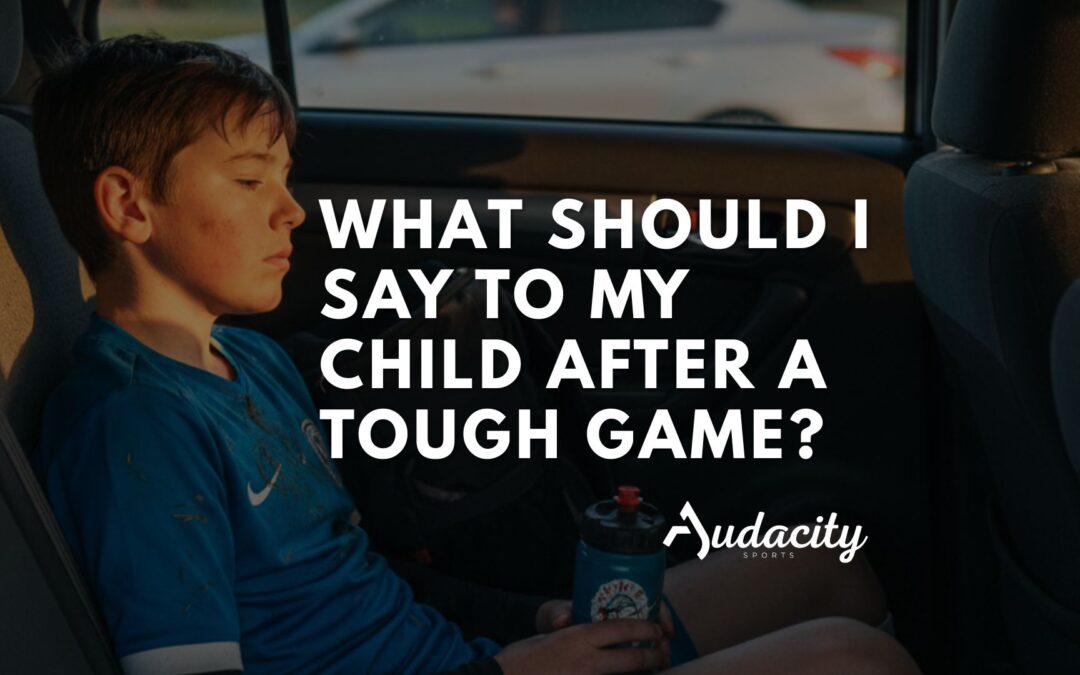
by Coach Carlo | Jul 14, 2026 | Mental Performance Tips, Sports Parenting
Quick Summary: The car ride home after a tough game is one of the most important — and most mishandled — moments in youth sports. Kids are raw, and what a parent says in the first few minutes can either rebuild them or deepen the sting. The short version: lead with connection, not analysis. Ask before you tell. And save the coaching for later, if at all.
Your kid isn’t looking for a post-game analyst on the ride home. They’re looking for a parent.
What should I say to my child after a tough game?
Start with five simple words: “I love watching you play.” Sports psychologists have pointed to this phrase for years because it does something powerful — it separates your love and approval from the result. After a loss, a kid is already wondering if they let you down. Leading with connection answers that fear before it grows.
Then go quiet. Let them set the tone. Some kids want to talk; many just want to feel normal again. Both are fine.
What should I avoid saying?
Avoid the instant breakdown of what went wrong, even when you mean well. In the raw minutes after a loss, “you should have…” lands as “you failed.” Also skip blaming refs, coaches, or teammates — it teaches kids to look outside themselves instead of focusing on what they control.
“In the raw minutes after a loss, ‘you should have’ lands as ‘you failed.’”
What is the best first question to ask?
Ask about experience before performance. A simple, low-pressure opener invites them in without putting them on trial.
The Ride-Home Reset
Three moves, in order
1. Connect
“I love watching you play.” Approval first, before anything about the game.
2. Ask
“What was that like for you?” Let them lead. Listen more than you talk.
3. Wait
Save any teaching for the next day, once the emotion has cooled — if it’s needed at all.
Why does the car ride home matter so much?
Because it repeats. Multiply one ride home by a whole season and you are training your child’s relationship with failure itself. Handled well, tough games become reps in resilience. Handled poorly, they become reasons to dread playing — and eventually, reasons to quit.
Frequently asked questions
What if my child wants to vent or cry?
Let them. Validate the feeling without rushing to fix it: “That one hurt — I get it.” Emotions move through faster when they are allowed, not argued with.
When is it okay to give feedback?
Later, and only if they are open to it. The next day, you can ask, “Want to talk about that play?” If they say no, respect it. Their coach handles coaching; you handle support.
My child shuts down completely. Is that bad?
No. Silence is a normal way to process. Stay present, keep it light, and let them know you are there when they are ready.
Win the ride home, and you win the season.
Audacity Sports — Mental Performance Academy for Youth Athletes

by Coach Carlo | Jul 14, 2026 | Mental Performance Coaching, Mental Performance Tips, Pressure & Composure
Quick Summary: Some kids seem to rise when the game is on the line while others freeze — and it is almost never about who has more talent. Thriving under pressure is a set of mental skills: settling the nerves, narrowing focus to the next play, and self-talk that helps instead of hurts. Those skills are teachable, and the RISE Method gives parents a simple way to start coaching them.
Pressure doesn’t create your child or break them. It reveals what they were trained to do with it.
Why do some kids thrive under pressure while others fall apart?
Watch two kids in the same high-stakes moment — last at-bat, game on the line — and you will often see two completely different athletes. One slows down and locks in. The other speeds up, tightens, and disappears. Parents tend to read this as a personality trait: one kid is just clutch, the other is not.
That read is wrong, and it is costly. The difference usually is not nerve or character. It is whether anyone ever taught that child what to do with the surge of adrenaline a big moment creates. The kid who thrives is not feeling less pressure. They have simply practiced a response to it.
Is performing under pressure a talent or a skill?
A skill. The body’s pressure response — racing heart, tunnel vision, shaky hands — is universal. Elite performers feel it too. What separates them is a trained routine for channeling it: a breath, a focal point, a cue word. None of that is innate. It is rehearsed until it becomes automatic, the same way a jump shot is.
“The kid who thrives isn’t feeling less pressure. They’ve practiced a response to it.”
What do pressure-proof kids do differently?
Three habits show up again and again in young athletes who stay composed when it counts:
What Pressure-Proof Kids Do
Three trainable habits
Play the controllables
They focus on effort, position, and the next action — not the scoreboard or the outcome.
Run a reset routine
A breath, a tap, a word — a quick physical cue that clears the last mistake and starts the next play.
Coach their own voice
They talk to themselves the way a good coach would — steady and constructive, not harsh.
How can parents help a child handle pressure?
Start before the pressure shows up, not during it. Practice a simple pre-performance routine at home so it is automatic by game day. Keep your own sideline energy calm — kids borrow their nervous system from the adults around them. And debrief games by asking about effort and decisions, not just results. This is the heart of the RISE Method: Regulate the body, Identify the feeling, Speak a better script, and Execute the next controllable action.
Frequently asked questions
My child is talented in practice but freezes in games. Why?
Practice has no pressure, so the physical skills flow. Games add adrenaline the child has not been taught to manage. The fix is rehearsing composure, not more reps of the physical skill they already have.
Can you really teach a kid to be clutch?
Yes. Composure under pressure is a trainable routine — breathing, focus cues, and self-talk — not a fixed personality trait. Kids get measurably calmer with practice.
At what age can kids learn this?
As early as 7 or 8, in simple forms. Younger kids start with one breath and one cue word; older kids build full pre-performance routines.
Pressure is trainable. So is the kid who learns to use it.
Audacity Sports — Mental Performance Academy for Youth Athletes